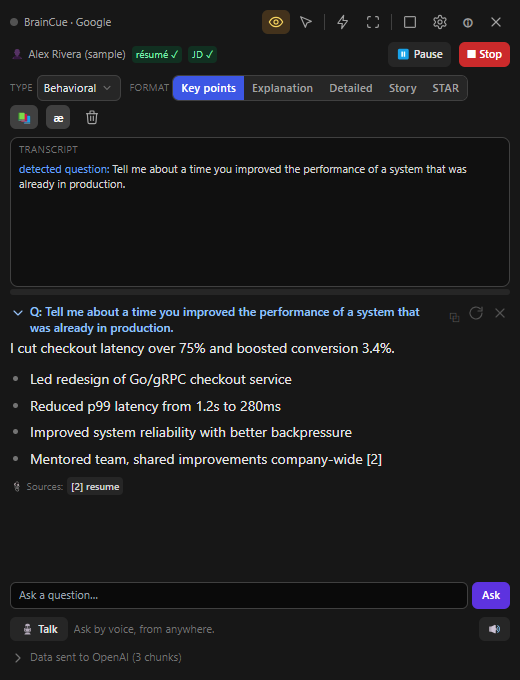
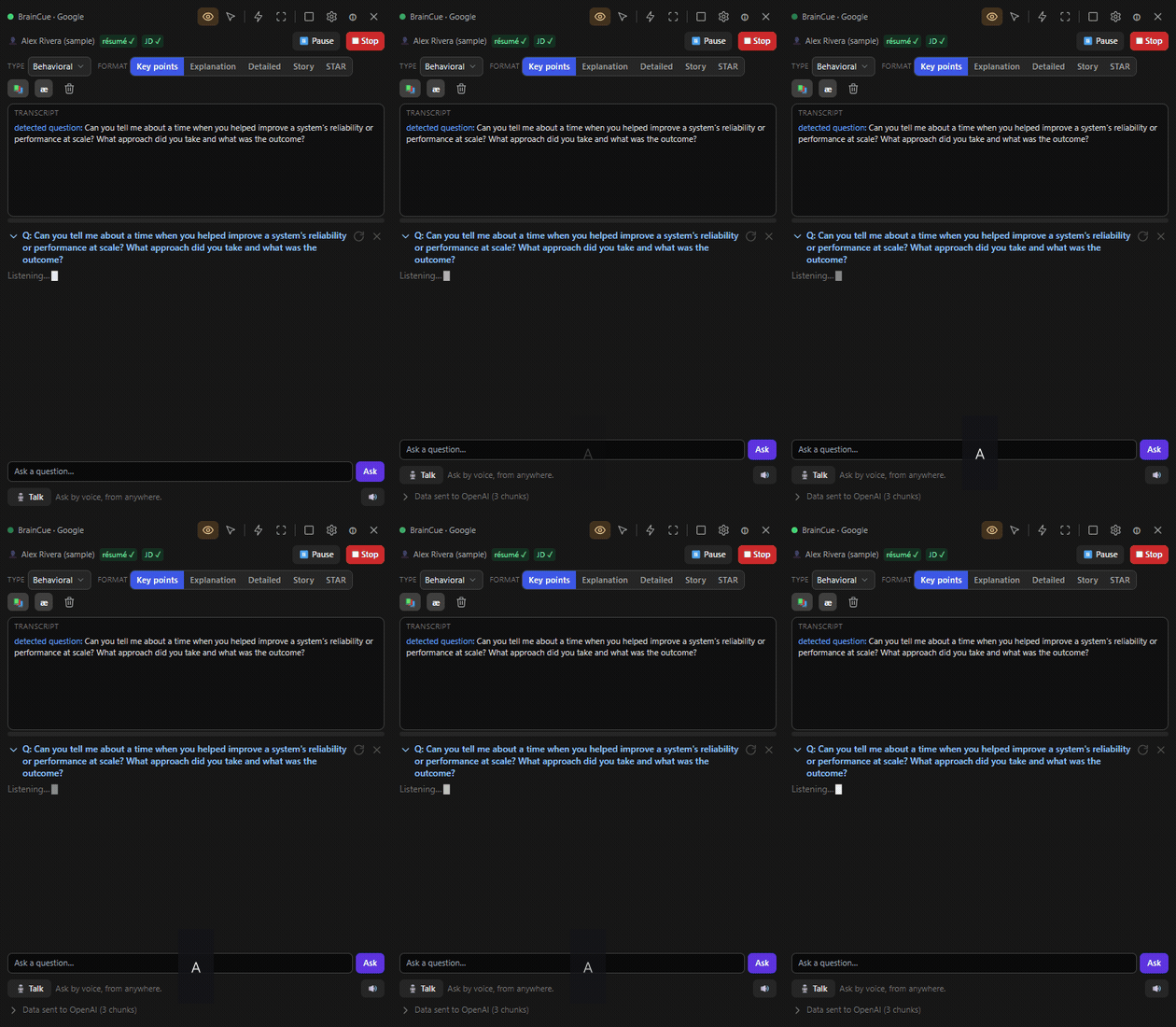
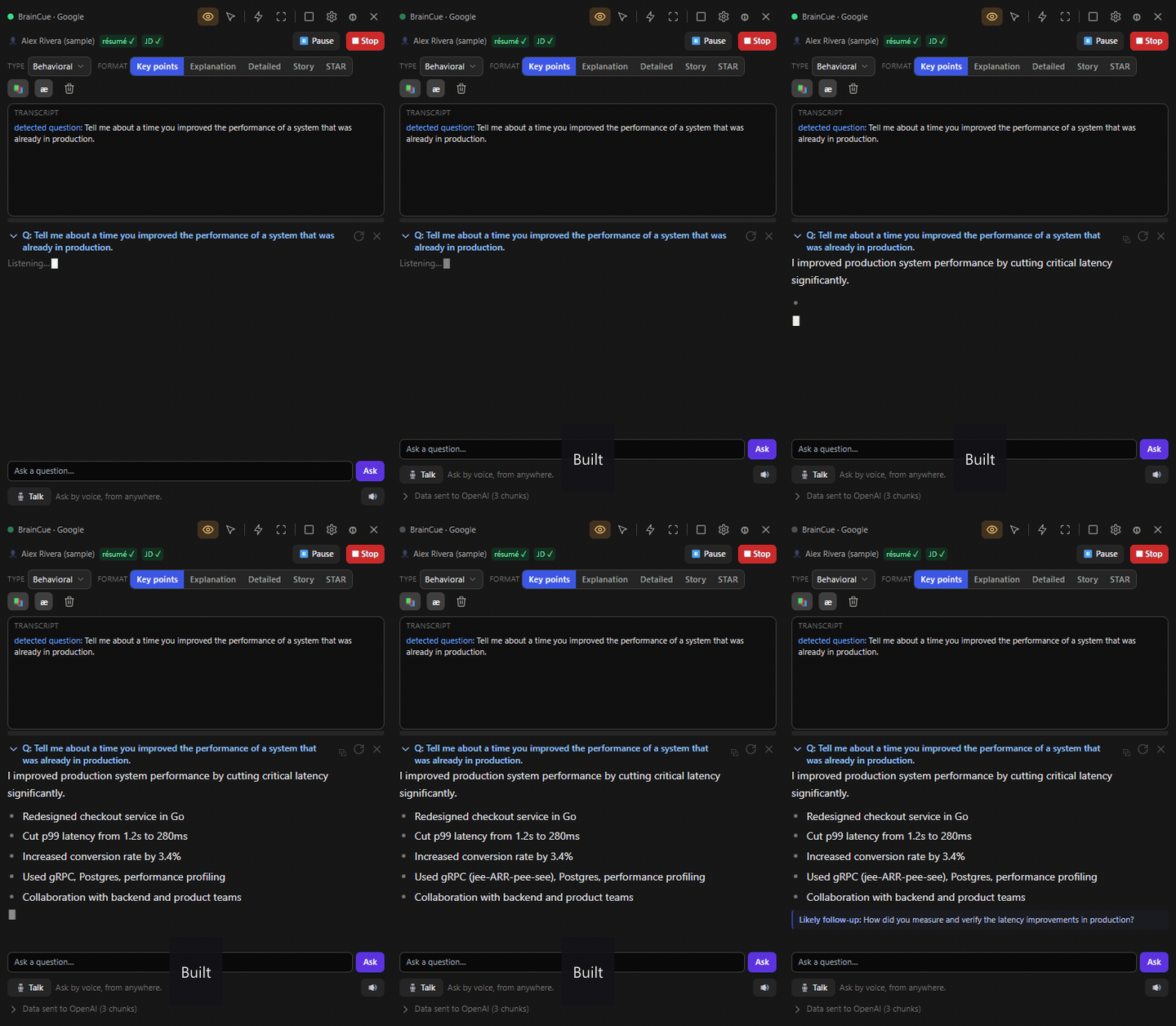
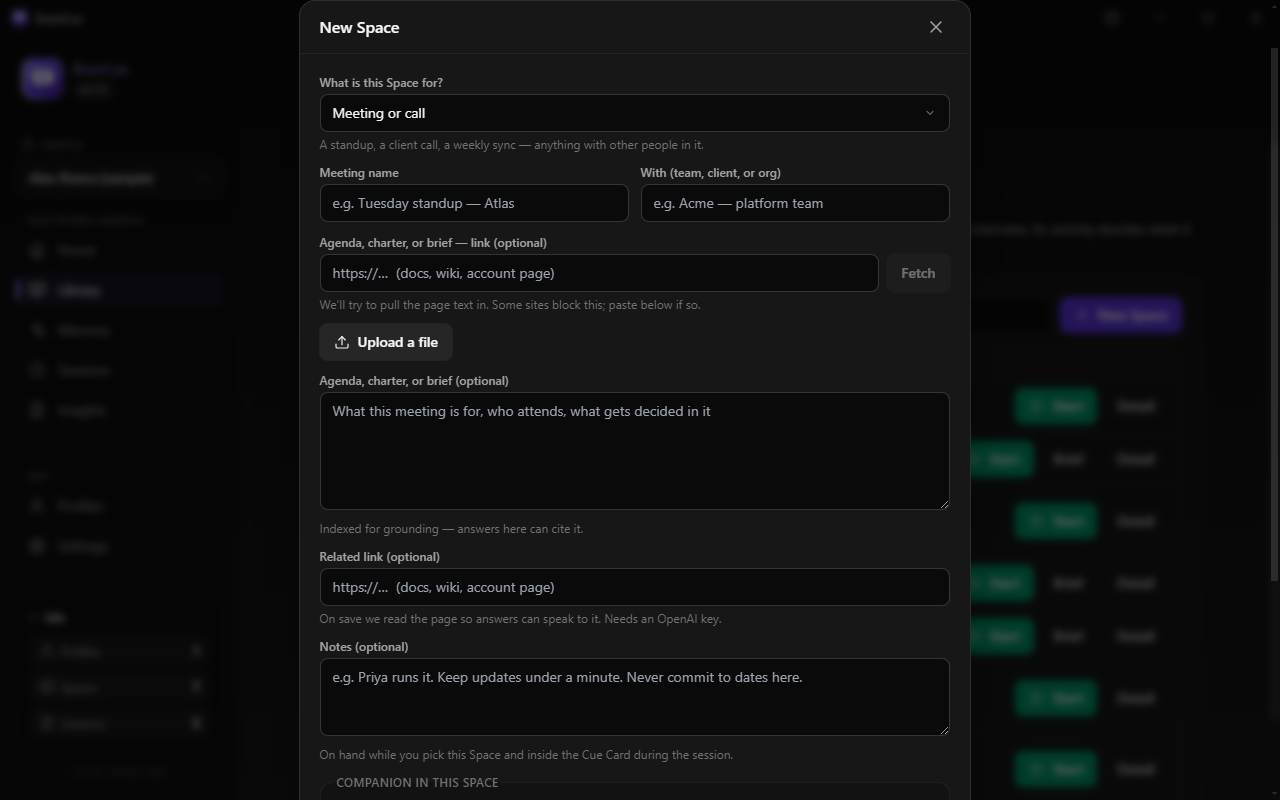
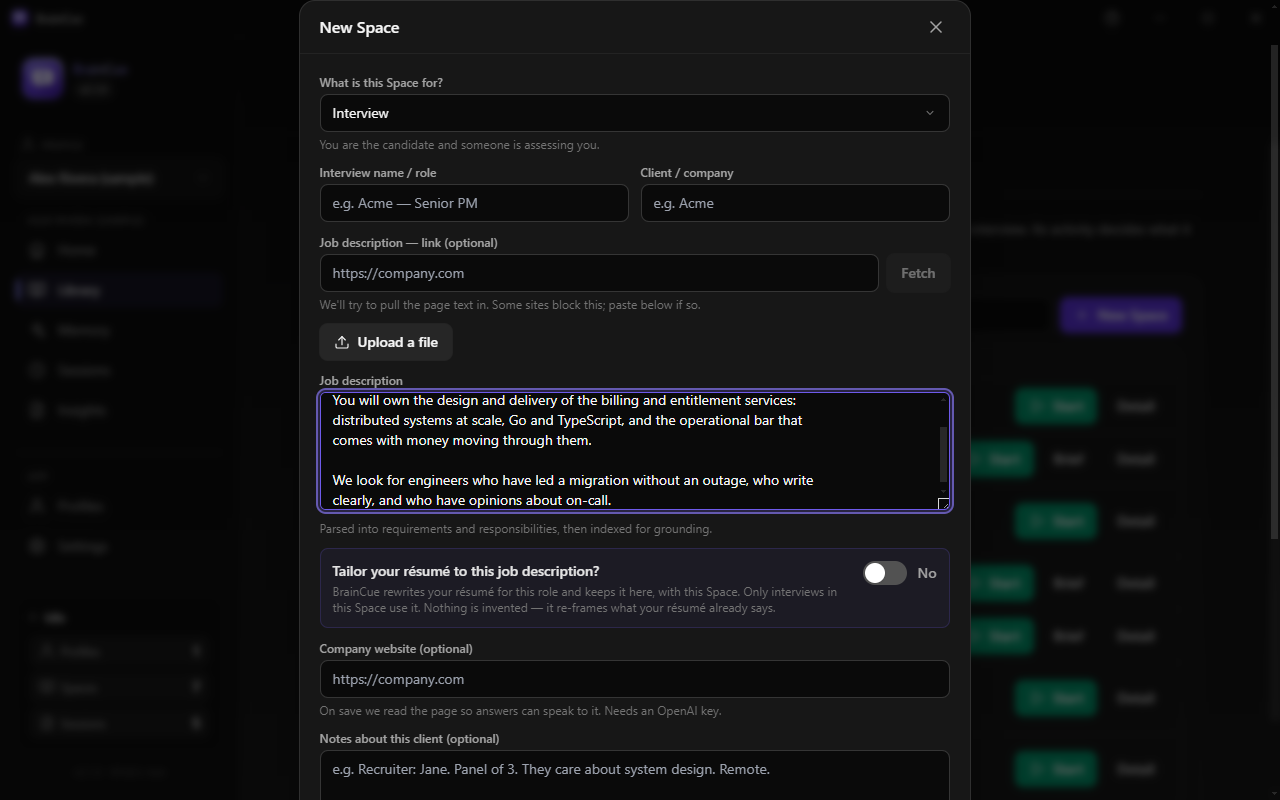
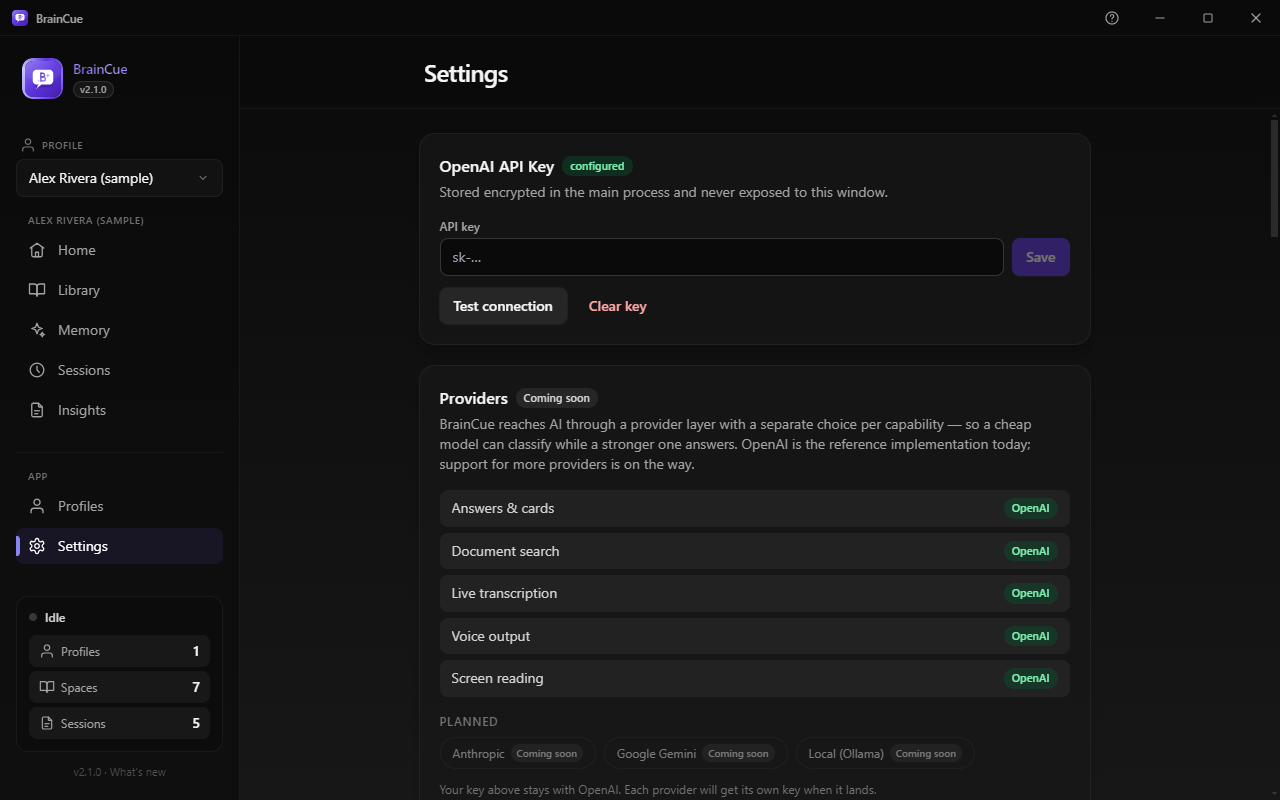
BrainCue hears the conversation you're actually in — a standup, a client call, an interview — contributes through a floating, screen-share-invisible Cue Card, and files what mattered back into the Space it happened in, so the next one starts where the last ended.
01 See it in action
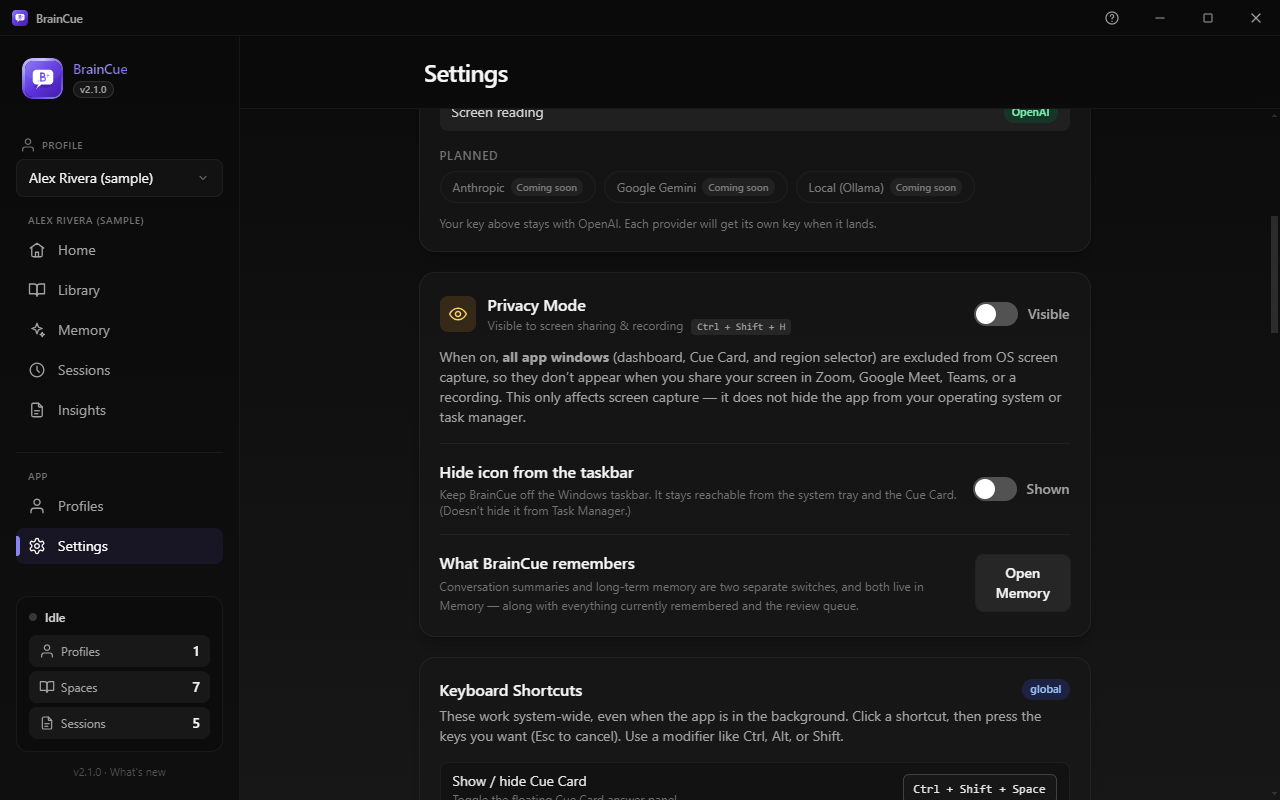
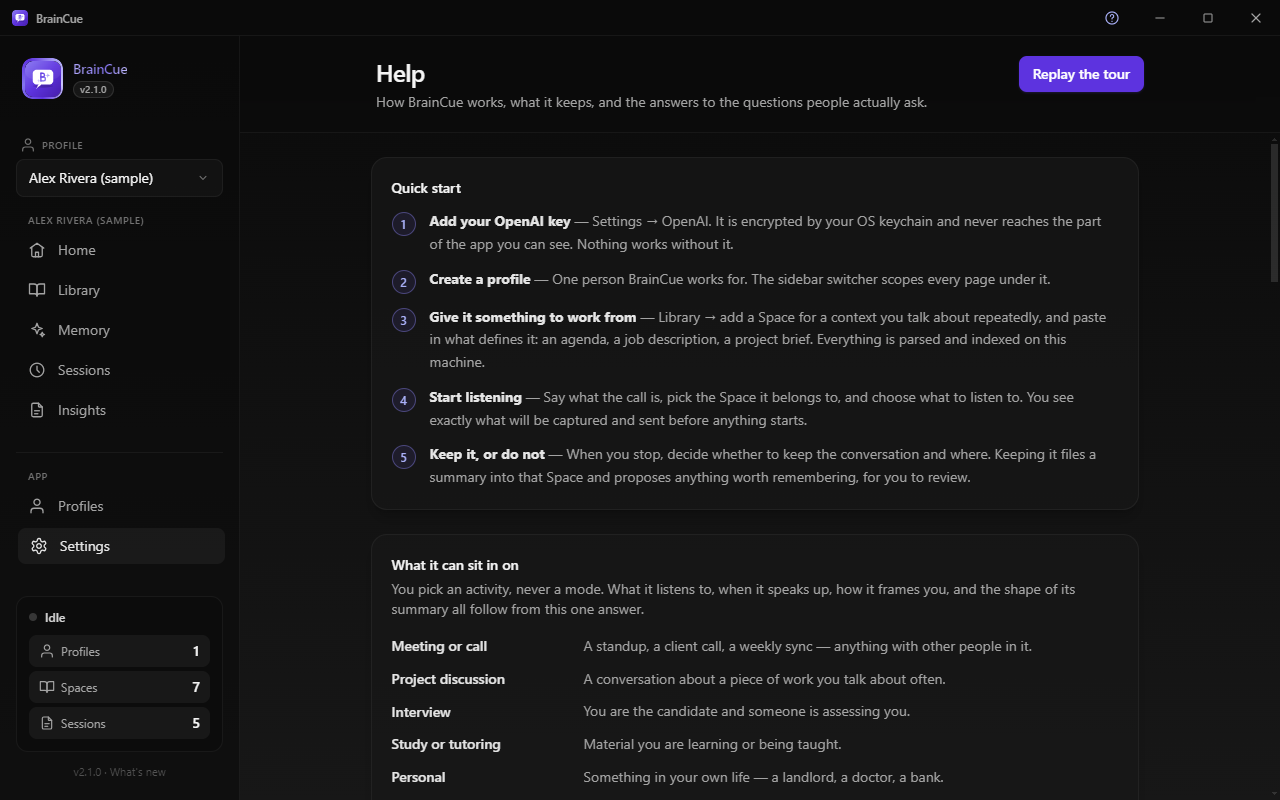
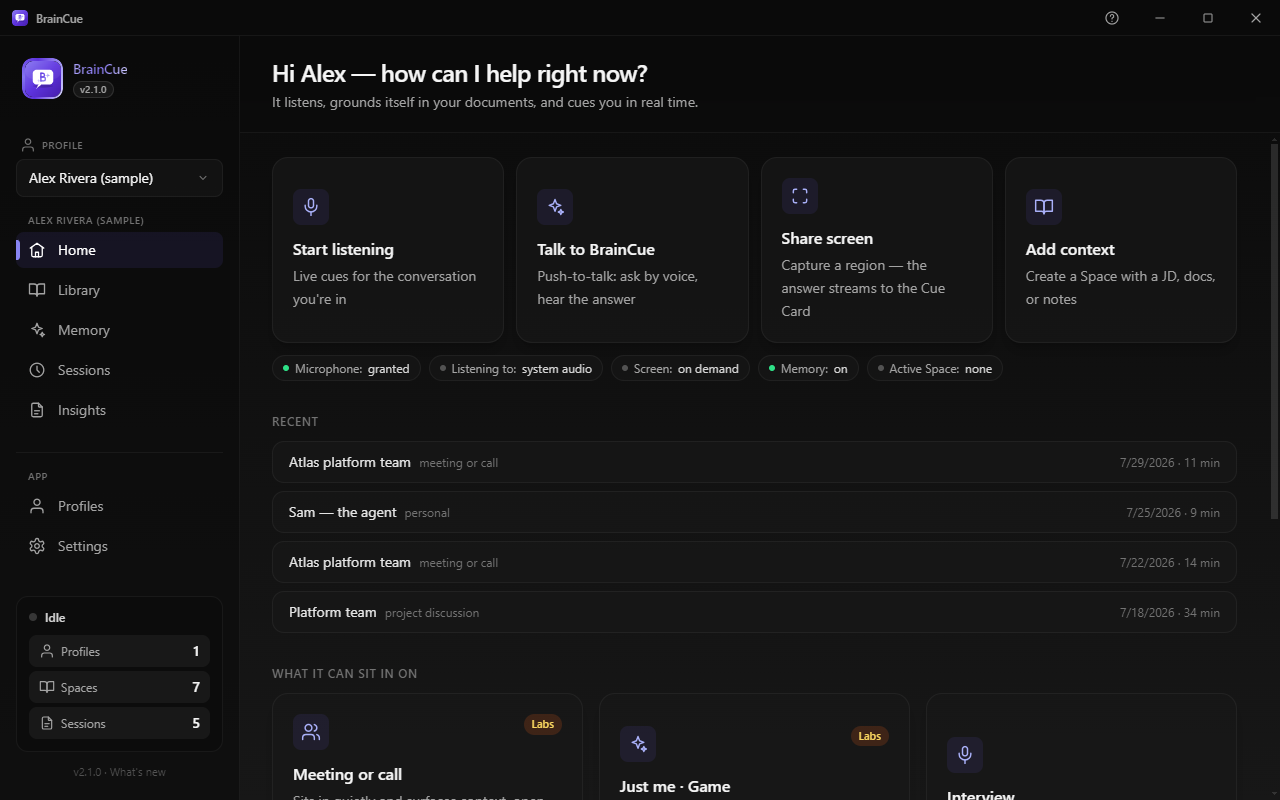
Every feature, end to end, captured from the running app by the repo's own e2e pipeline — what it knows before a call, what it does during one, what survives afterwards, and why none of it leaves your machine.
02 How it works
Everything BrainCue does is the same engine cycle. The activity you pick tunes the thresholds — how eager it is, what it grounds in, and where the answer goes.
System-audio loopback hears your calls; the microphone covers the room. Everything is transcribed live, on your key.
Trigger policies watch for the moment worth answering — a question aimed at you, an action item, a summon. Quiet by default.
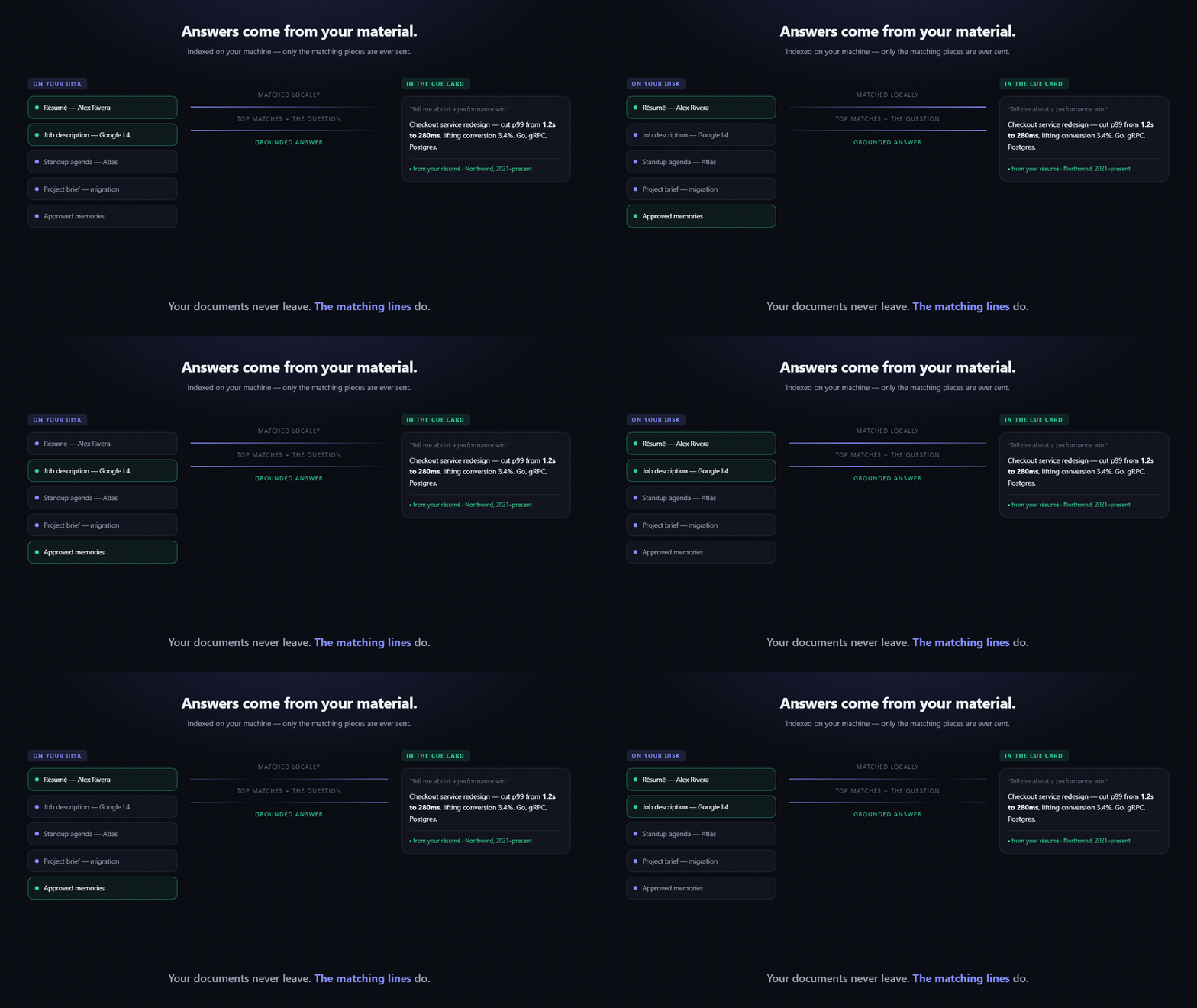
On-device retrieval pulls the relevant lines from your résumé, notes, and approved memories — only that context is sent out.
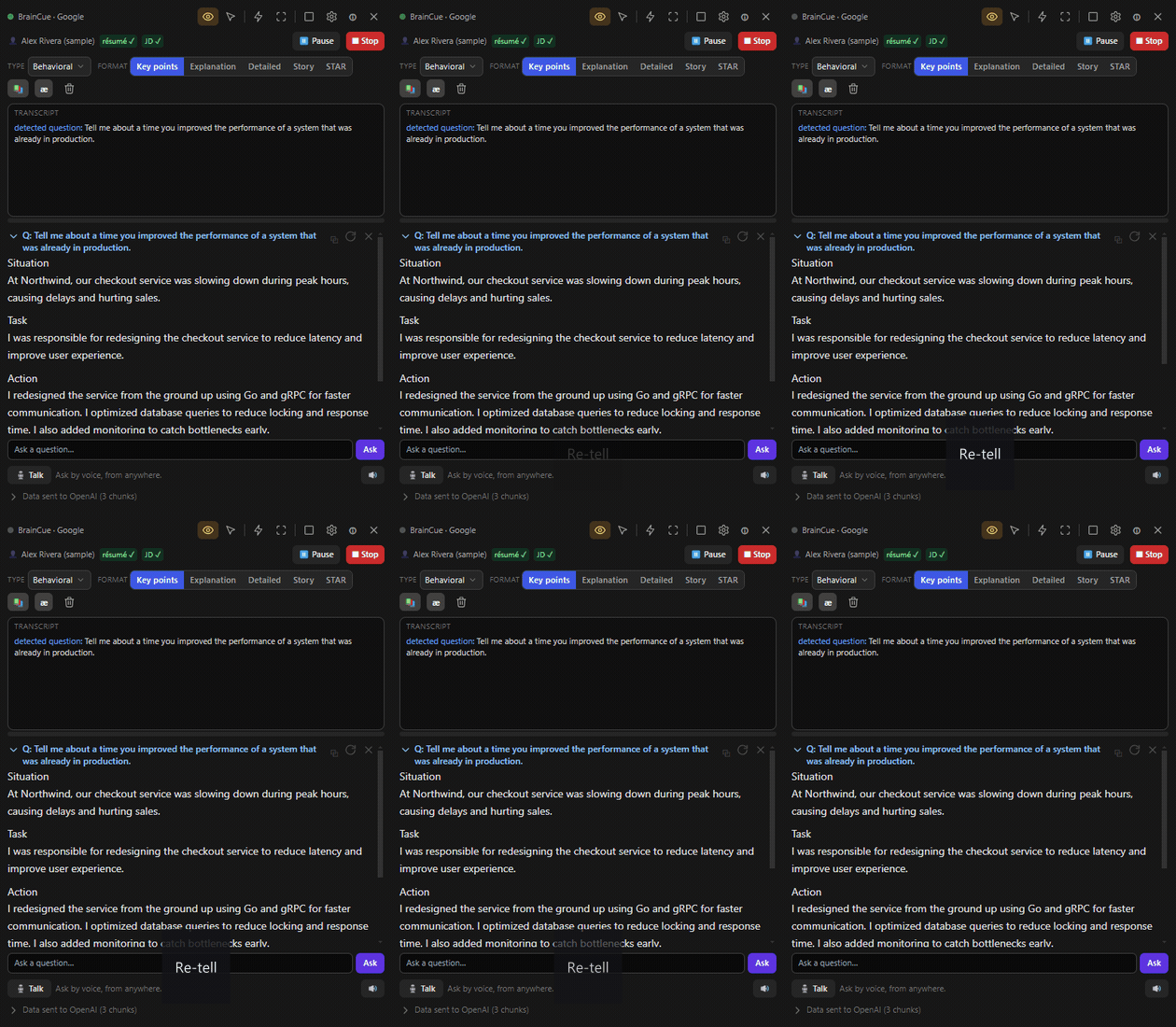
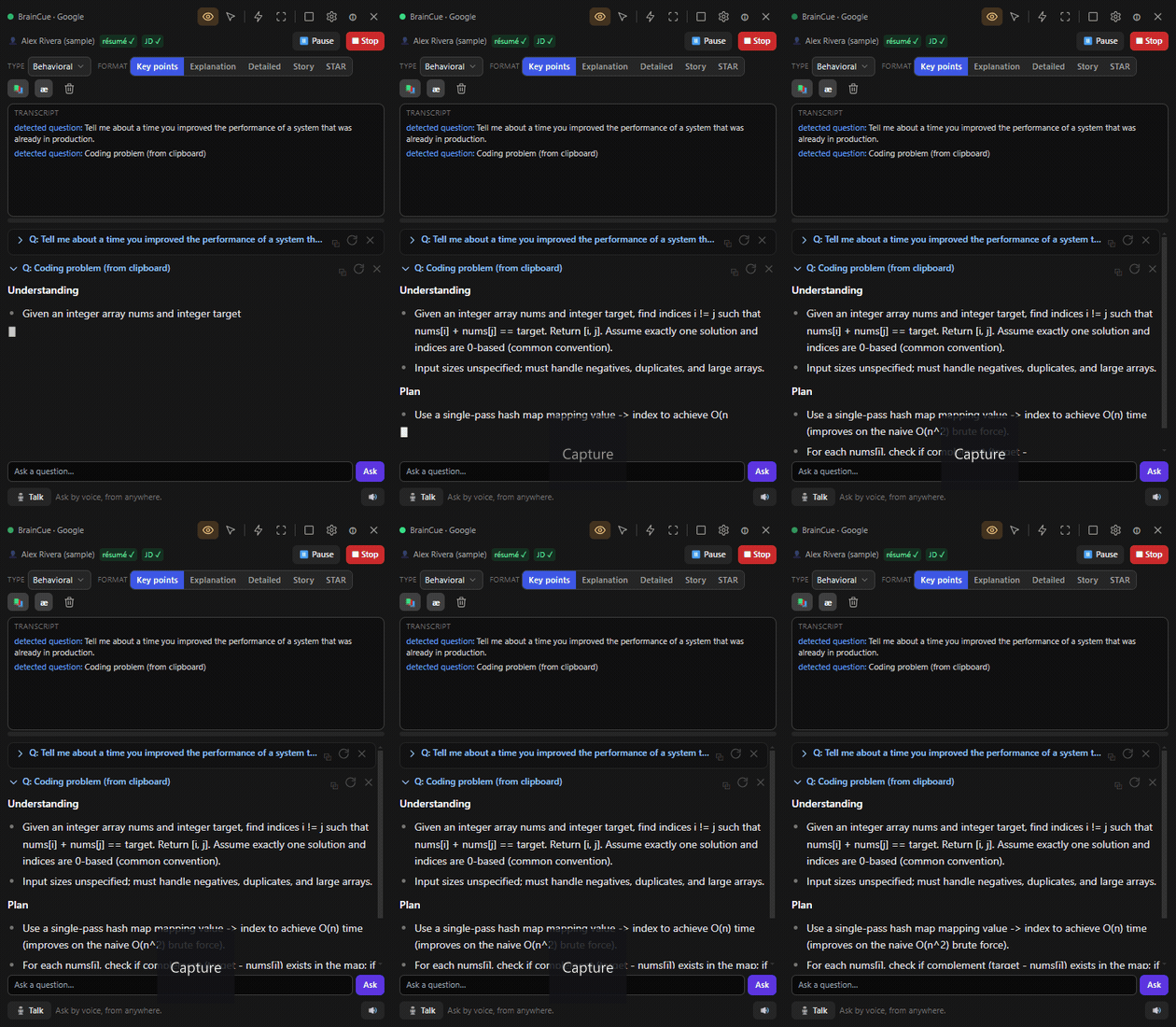
A cited answer streams into the screen-share-invisible Cue Card — or is spoken aloud, stopping the moment you talk over it.
03 One start flow
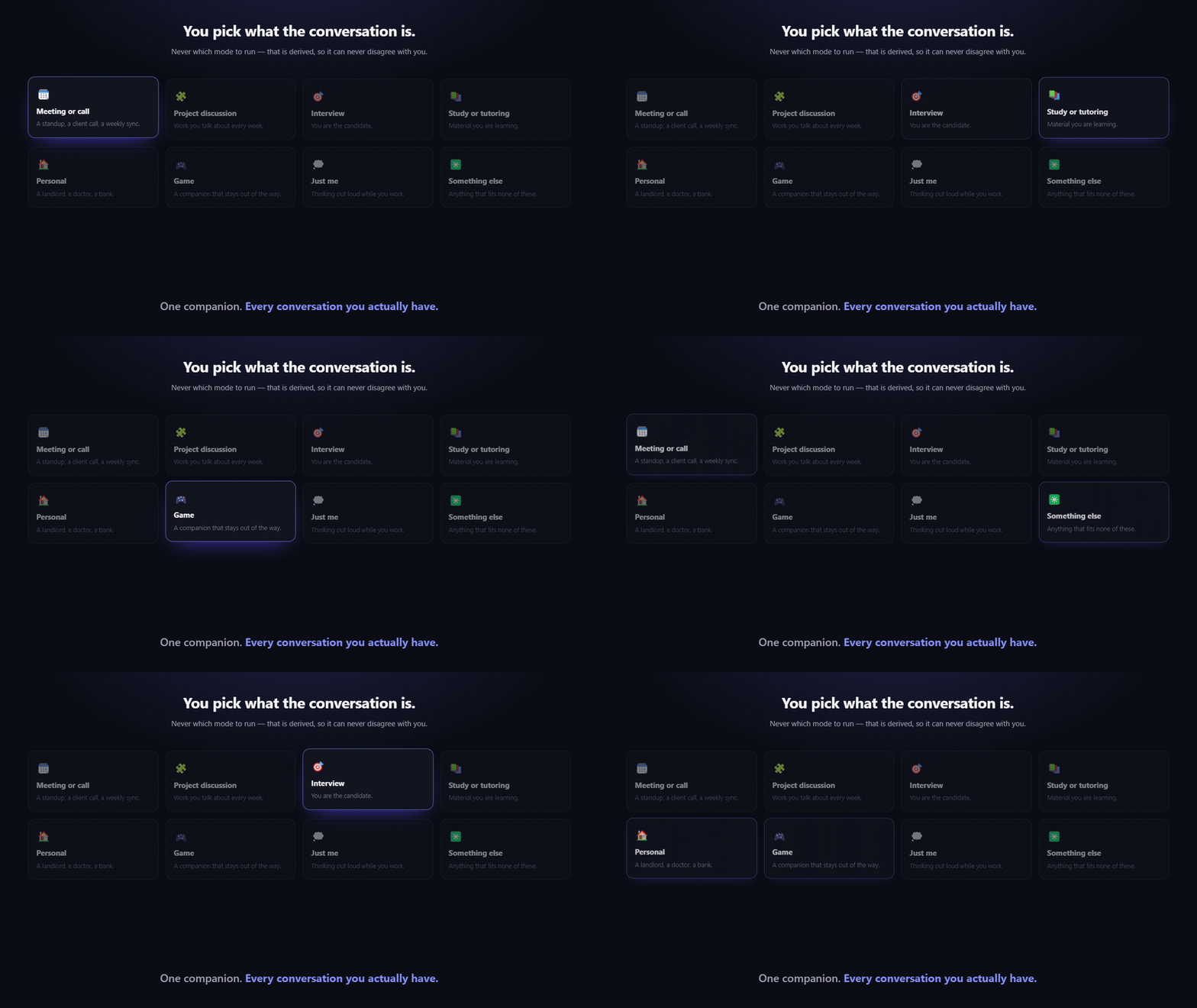
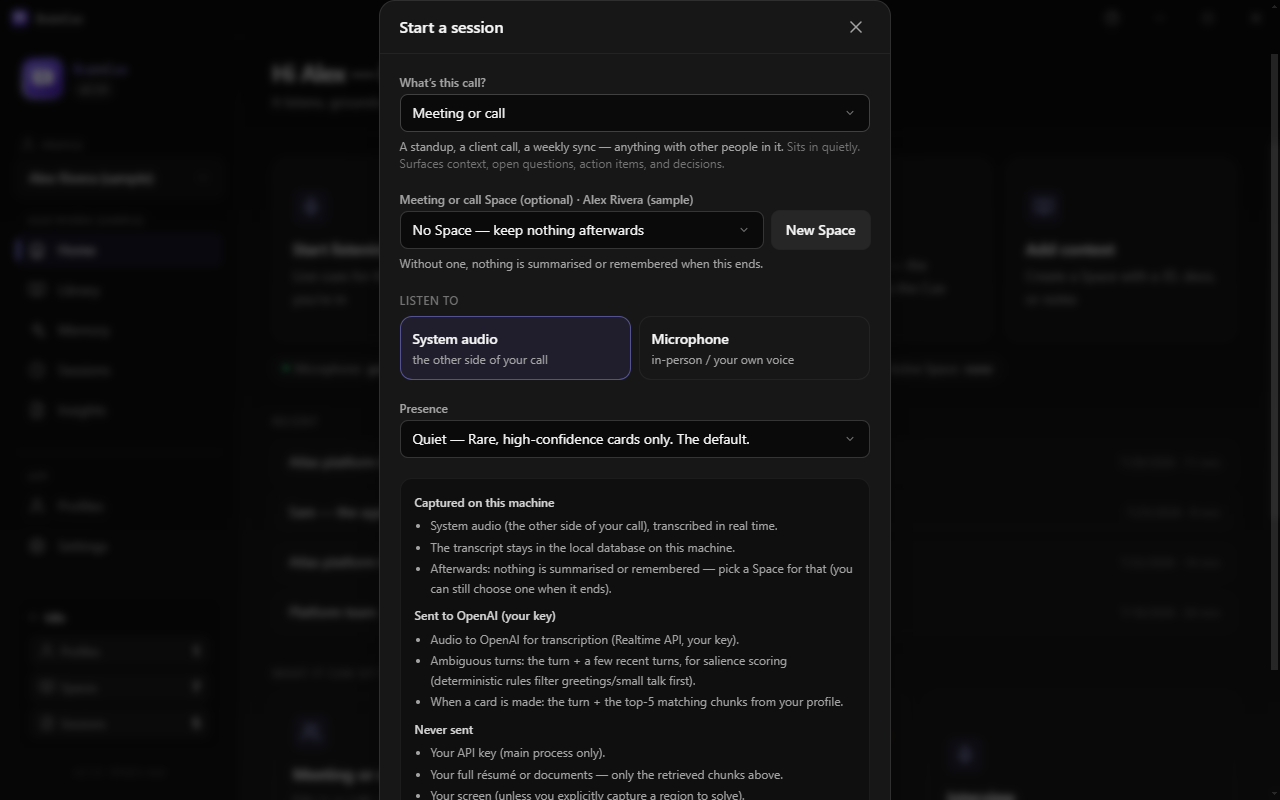
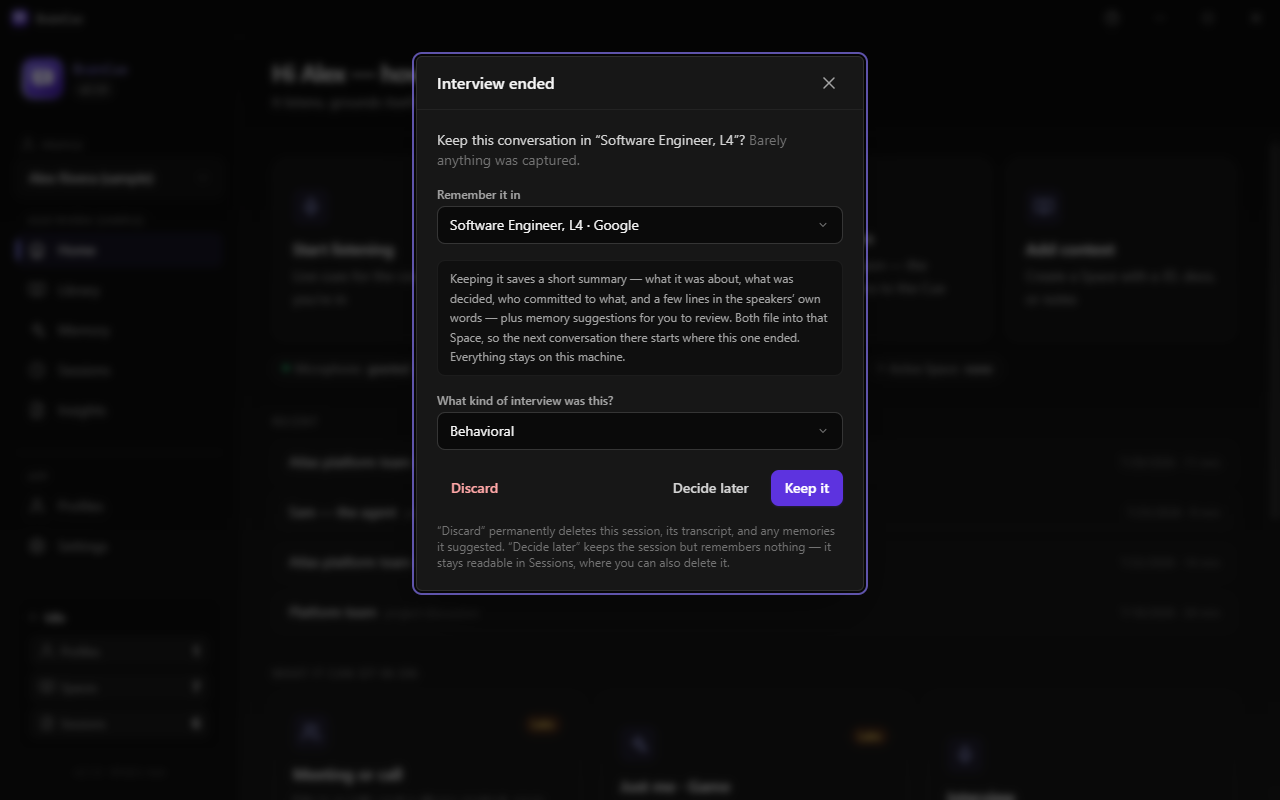
One question opens every session — what’s this call? Everything else follows from the answer: what it listens to, when it speaks up, how it frames you, and what shape its summary takes afterwards.
A standup, a client call, a sync
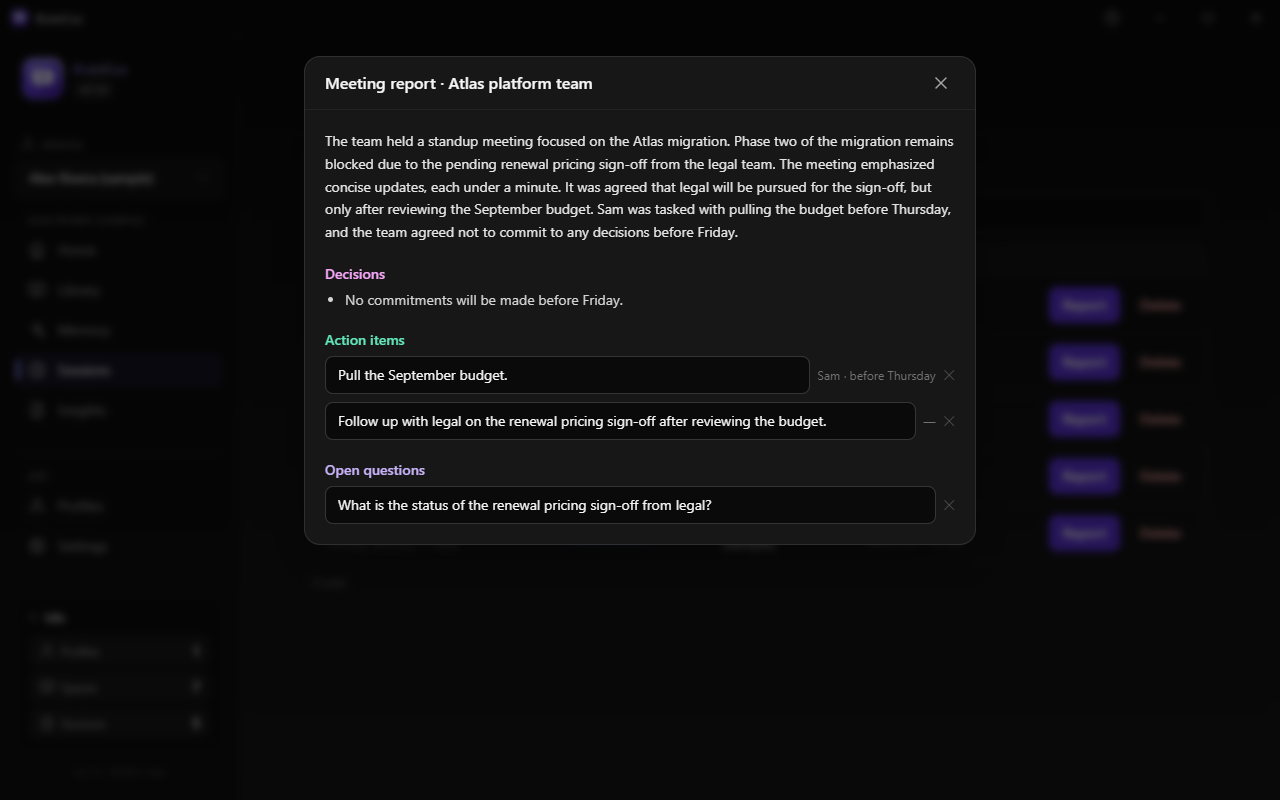
Answers questions asked in the room, and surfaces context, action items, and decisions — only above a confidence threshold you set.
Work you talk about often
Recalls what was decided in earlier conversations about it, what is still open, and what just got committed to.
You’re the candidate
Detects each question and streams a grounded answer cue into the Cue Card — retellable live as key points, an explanation, or a STAR story.
You’re learning something
Pulls up the part of your own material that bears on what was just said. Full voice dialogue and drills are still to come.
A landlord, a bank, a doctor
Keeps the background straight across a long-running thing in your life, and catches what you agreed to.
Playing, or thinking out loud
An ambient presence that stays out of the way — behind deterministic gates, quiet hours, and a hard spend cap.
Underneath, these run three engine modes over one pipeline. The mode is derived, never chosen — picking a mode and a category was the same question asked twice, and the two answers could disagree. How that works →
04 Continuity
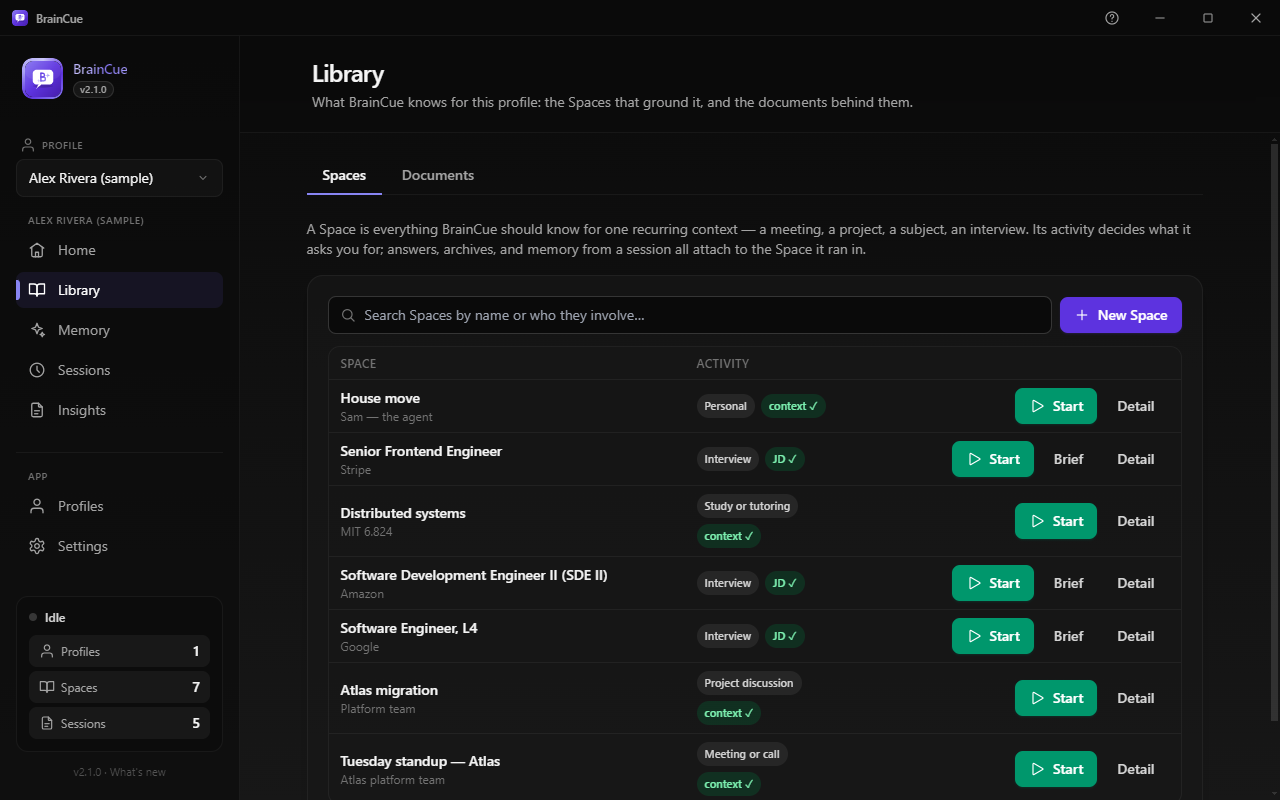
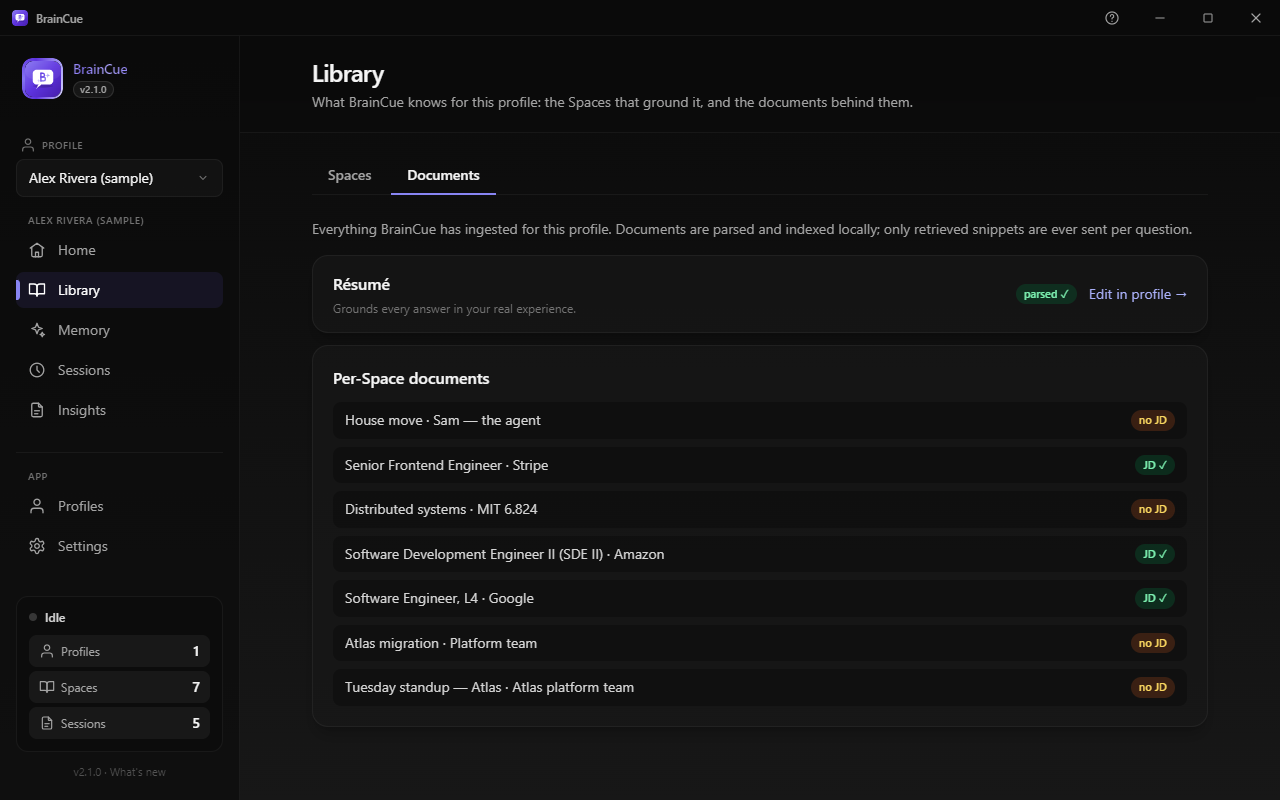
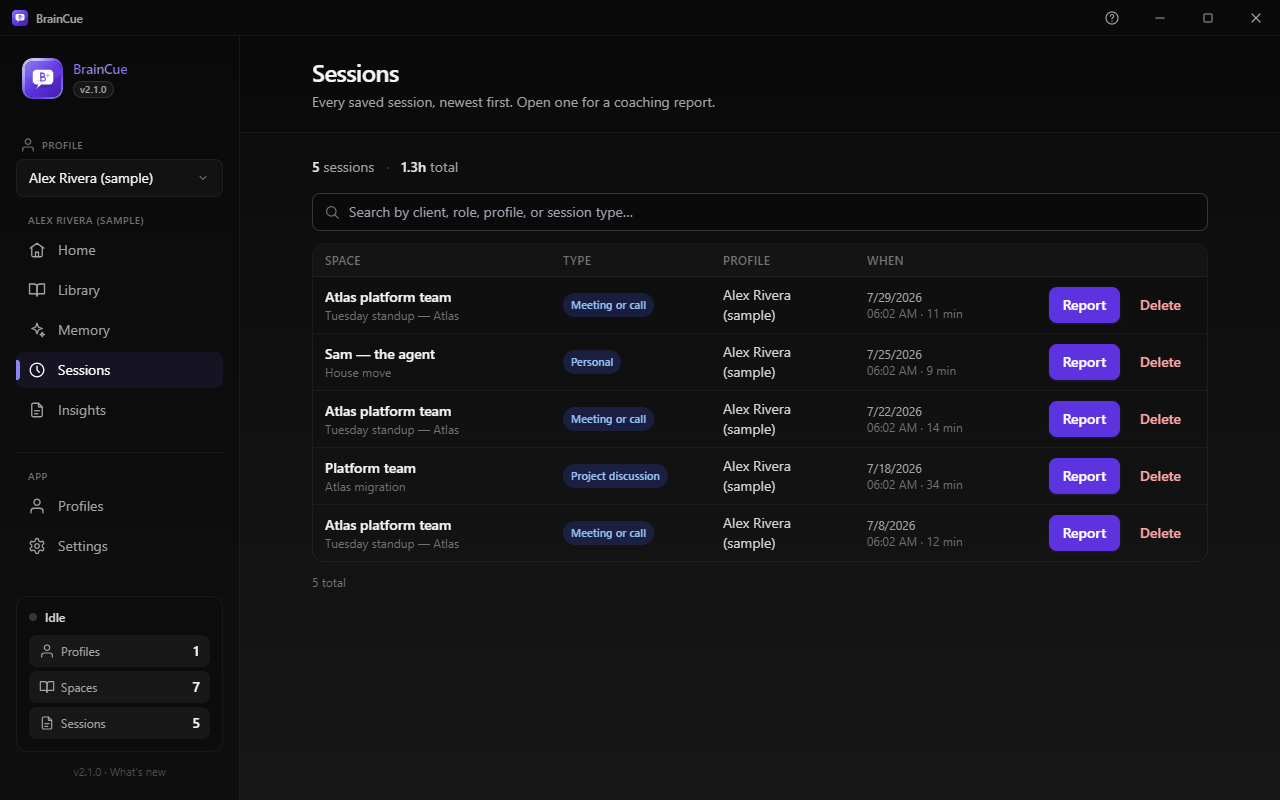
A Space is one recurring context — Tuesday standup, Senior engineer · Acme, House move — holding the documents that ground it. It is also where a conversation is kept. When a session ends you choose whether to keep it, and where. With no Space, nothing is summarised and nothing is remembered: it helped live, and leaves only its transcript.
What that conversation was
“Phase two is blocked on renewal pricing. Priya is chasing legal.” Written in a shape that fits the activity — a meeting leaves decisions and action items; an interview leaves what they asked and what you claimed. Filed into its Space, retrievable by the next conversation there, and deleted with its session.
What is true about you
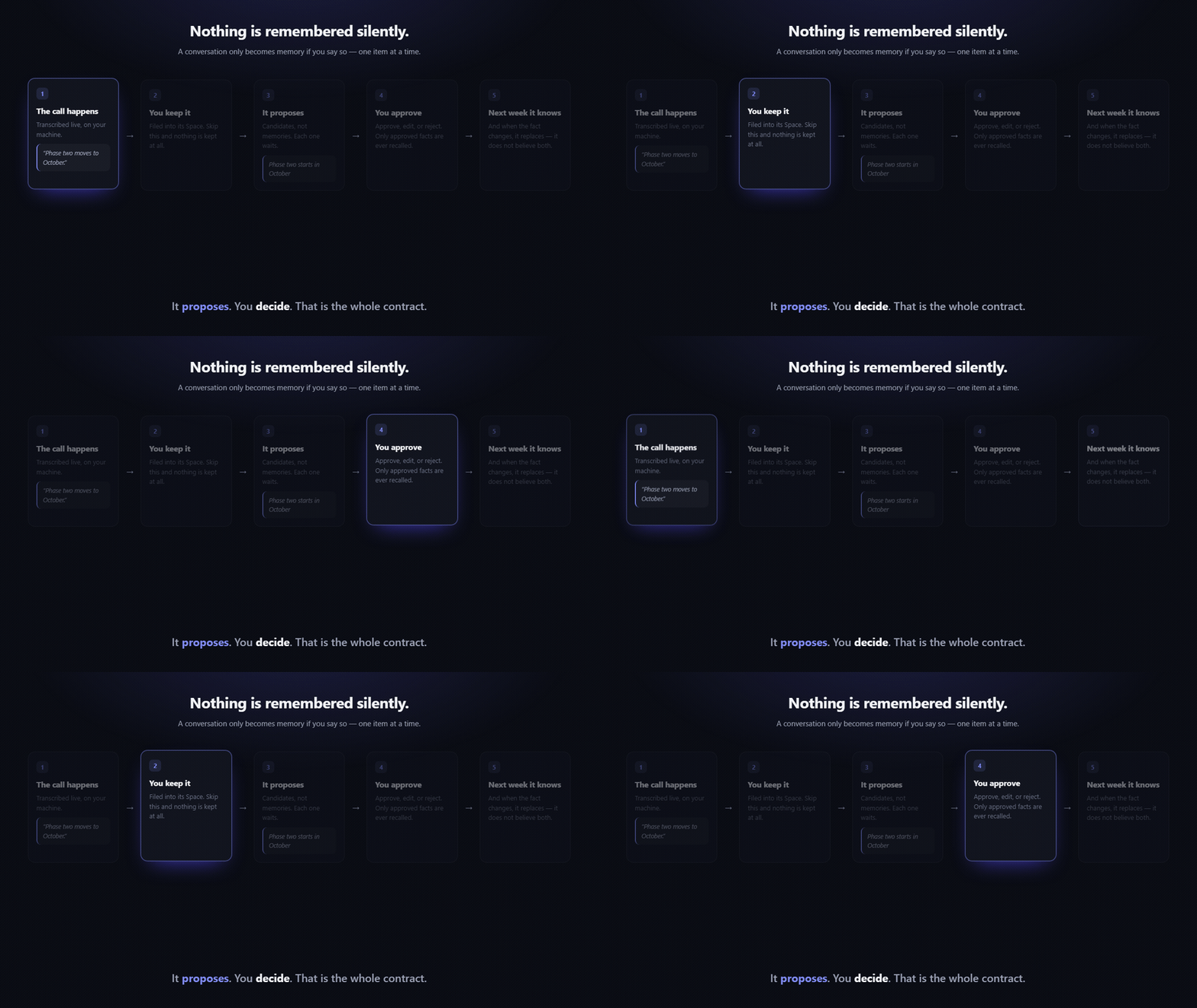
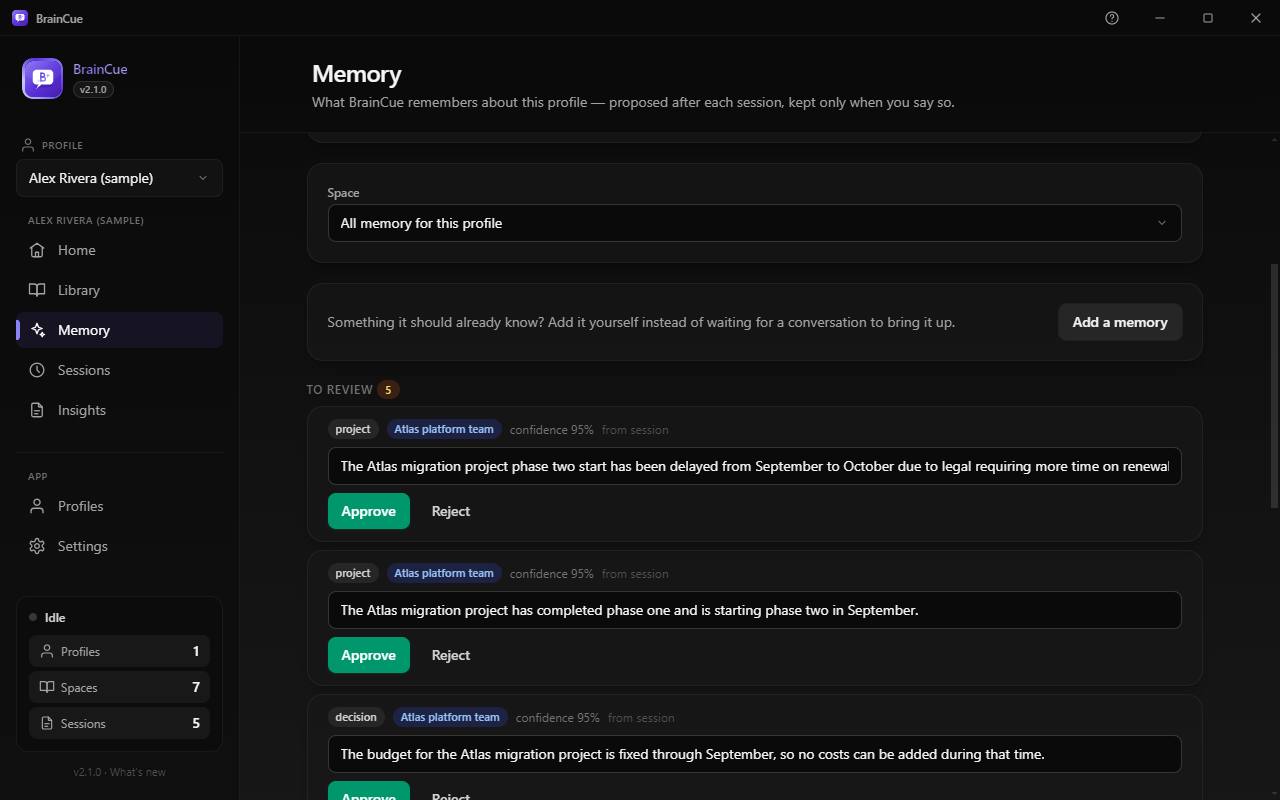
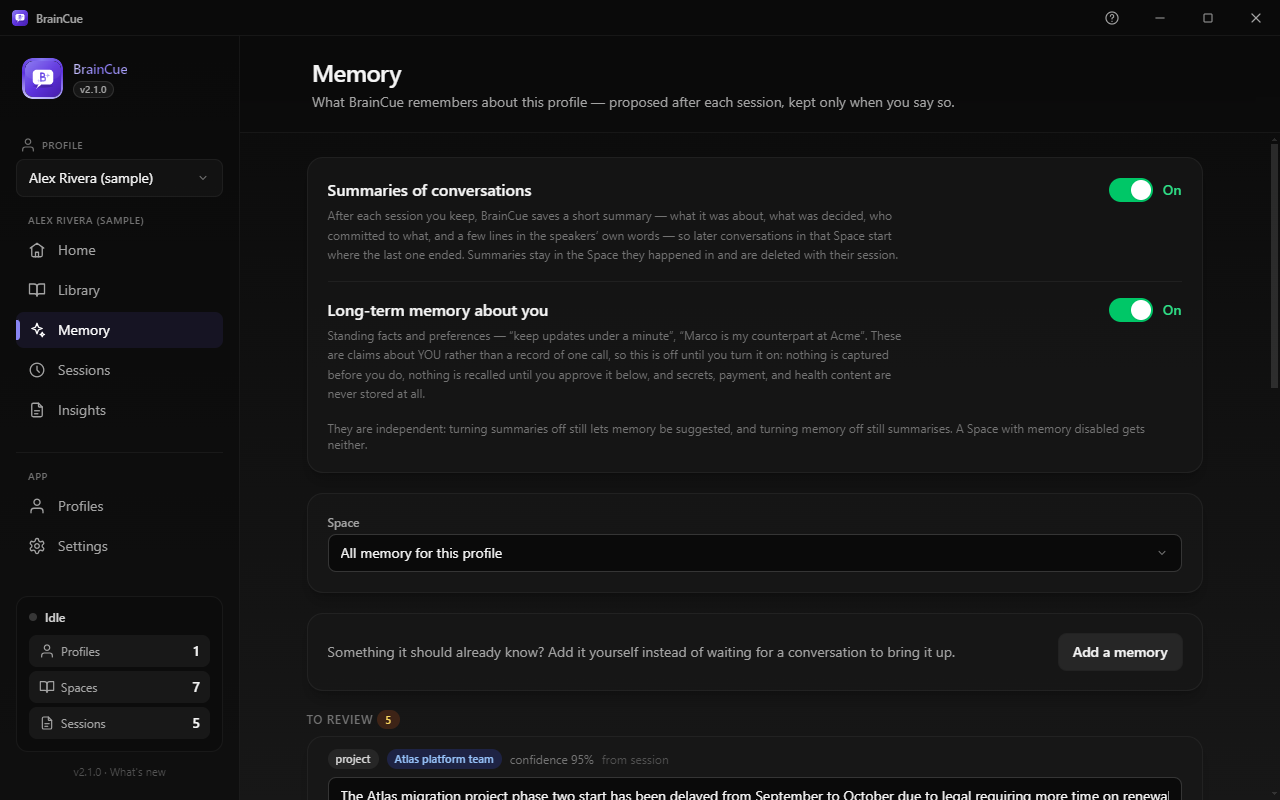
“Never commits to dates in standup.” A standing claim about a person — and a wrong one would be repeated forever, so nothing is ever remembered silently. Memories are proposed after a session and only the ones you approve are ever recalled. Editable and deletable, one at a time.
Two promises, two defaults, two switches. Turning memory off means unused, not deleted — re-enable it and what you approved comes back intact. The full contract →
05 Why BrainCue
System-audio loopback puts it inside your actual calls and meetings; a microphone covers in-person. It flags the moment worth responding to, as it happens.
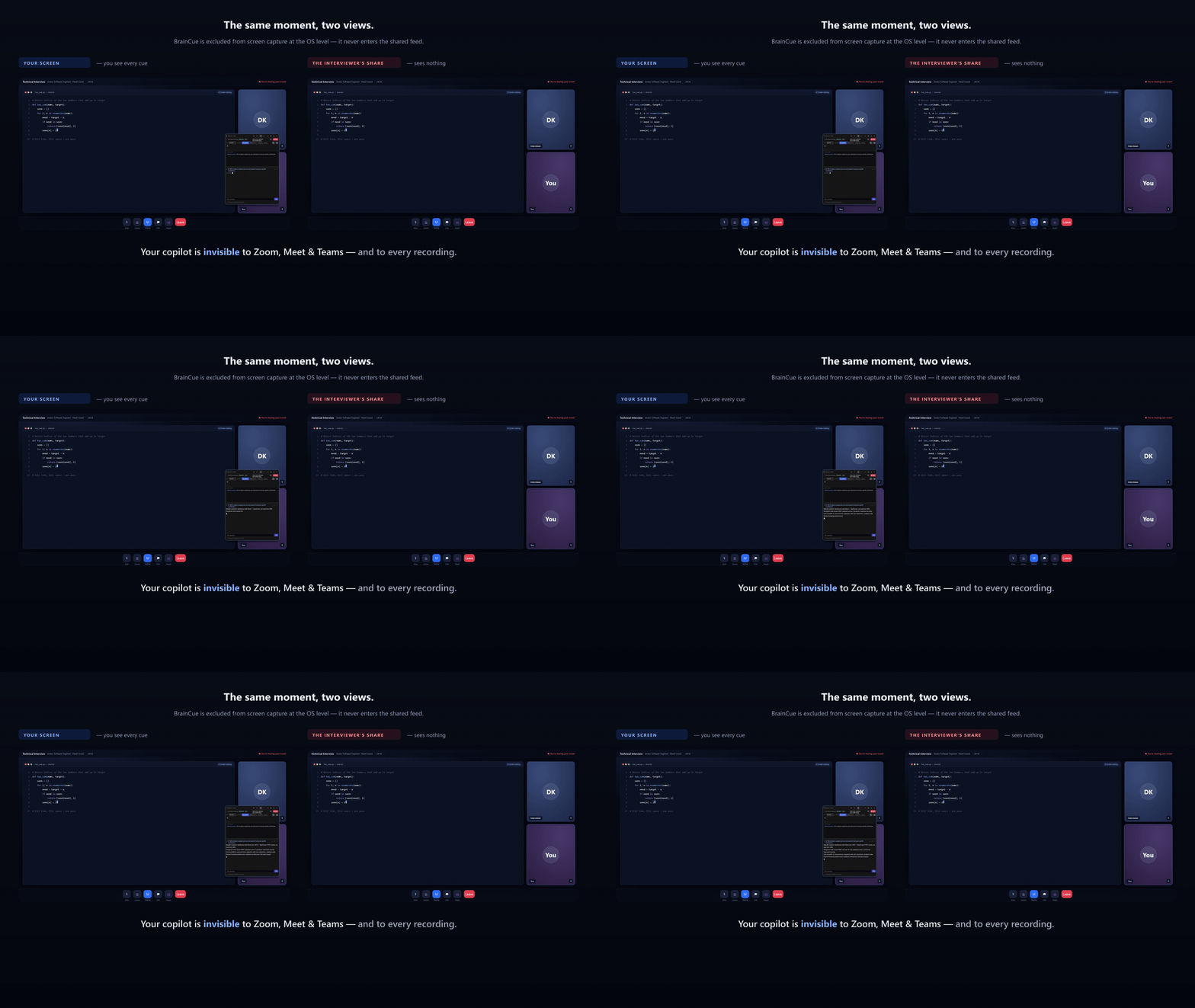
The Cue Card is always-on-top for you and excluded from screen capture and recording for everyone else — OS-level window affinity, not a trick.
Answers are retrieved from your résumé, job descriptions, and notes by on-device search — and it says when it doesn't know instead of inventing.
Push-to-talk from anywhere: ask by voice and hear the answer back. Start talking over it and it stops to listen.
It can remember across sessions, but nothing is kept silently — memories are proposed, and only ones you approve are ever recalled. Correct or forget any of them.
Data lives in a local database. Your API key is encrypted by the OS keychain and never leaves the main process — the UI only ever learns whether one exists.
06 A look inside
07 Documentation
The design documents below are the source of truth the implementation follows — not a write-up produced after the fact.
08 Built in the open
BrainCue is developed in public with a shared board, a written roadmap, and a contributing guide that says exactly how work gets in.
Typecheck, tests, and a full build run on every pull request. The design docs lead the code, and every change that alters documented behaviour updates the doc in the same PR.
A failed check is a fix window, not a rejection. When a maintainer approves and CI is green, the PR merges automatically — no second click, no waiting.
Work starts from labeled issues — features, tests, docs, performance, security — triaged by a maintainer and tied to a roadmap milestone. The accepted label means it is ready to build against.
09 Get it
Grab the latest installer from the releases page. Builds are currently unsigned, so the OS may warn on first launch — Windows SmartScreen ("More info → Run anyway"), macOS Gatekeeper (right-click → Open).
| What you need | Minimum | Recommended |
|---|---|---|
| OS | Windows 10 64-bit (build 19041+), macOS 11, or modern 64-bit Linux | Windows 11, macOS 13+ |
| RAM | 4 GB | 8 GB+ |
| Audio | Microphone | Mic + system-audio loopback |
| Network | Broadband | Low-latency broadband |
| AI key | Your own OpenAI API key (Realtime/STT, Responses, embeddings, TTS, Vision). More providers planned. | |
Privacy Mode is most reliable on Windows 10 build 19041+ and Windows 11. On macOS, capturing system audio needs a virtual audio device (e.g. BlackHole); the microphone path works without one.